Independent
No truck, charger or financing product to sell.
Independent electric HGV advisory
One real route or transport contract, translated into a clear go, pilot or wait decision.
Maximum truck priceMaximum charging tariffMinimum annual kilometres
No truck, charger or financing product to sell.
Built around your contract economics, not catalogue range.
Concrete limits for management and supplier negotiations.
The question we answer
Range can be found in a brochure. The difficult decision is whether the vehicle, charging plan and customer contract work together without weakening your margin.
Proceed only if the net truck price is below €X, electricity remains below €Y/kWh and annual utilisation exceeds Z km.
Which existing route is the strongest first candidate?
What is the highest safe truck and charging price?
What contract term or customer premium is required?
What changes if toll support or subsidies disappear?
Free route scan
The first scan covers one real route or transport contract. It is intentionally focused: enough to expose the commercial opportunity before you invest time in a full fleet transition study.
Submit a route for analysis ↗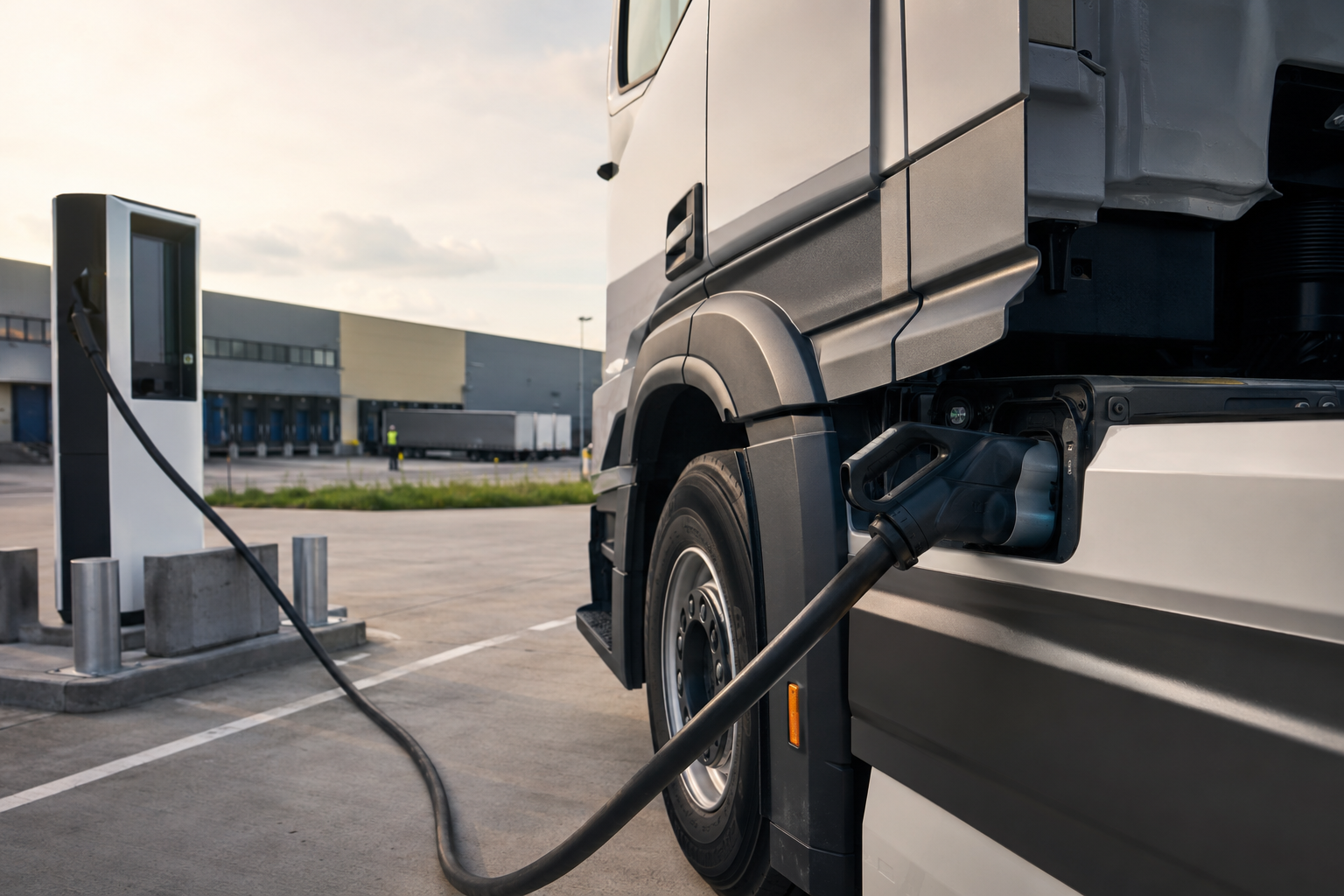
Charging is part of the contract
A cheaper charger can become expensive if it creates lost driving time. Public charging can work if it overlaps with a mandatory break. Customer-site charging can change the economics completely.
Simple process
Distance, operating days, current truck, fuel use, payload and available dwell time.
Vehicle, charging, toll, subsidy and contract scenarios are tested against the diesel baseline.
A concise PDF with break-even boundaries, risks and the next practical action.
About E-WEG
E-WEG helps road transport companies determine where electric HGVs make operational and financial sense. We translate route and fleet data into clear investment conditions and a practical go, pilot or wait decision.
Each assessment connects route feasibility with the complete commercial picture: vehicle and energy costs, charging options, utilisation, tolls, subsidies, customer contracts, infrastructure requirements and implementation risks.
E-WEG operates independently of truck manufacturers, charging providers, lessors and financiers. The analysis is built around the carrier’s economics—not around products that need to be sold.
The goal is simple: prevent premature investment, identify the strongest routes for electrification and establish clear break-even conditions for scaling with confidence.
Common questions
Yes. It covers one route or contract and is used to validate the methodology with real carrier situations.
No. A recent route summary, approximate payload, current fuel use and operating schedule are sufficient for the initial scan.
Suitable market options can be compared, but the primary output is the commercial boundary within which any selected vehicle must perform.
Only information needed for the agreed analysis is requested. It is not published or shared with suppliers without permission.
Free route scan